Showing posts with label Tor. Show all posts

Sunday, February 9, 2014

Gene Wolfe


Did you know that Gene Wolfe was an industrial engineer who helped design the machine that makes Pringles potato chips? He's also one of my favorite authors, even though I am not particularly fond of potato chips.

I've read quite a bit of his work-- short fiction, long fiction, series, etc., even some poetry-- but not all of it. At the recommendation of a friend, I'm currently reading Peace. It's reminding me a bit of the Wizard Knight series, maybe, at least in its frame. Gene Wolfe likes using the frame tale as a device, and he's very good at it.

[*Edit: Oh wow...I finished Peace last night and immediately started rereading it. What a book. It wasn't at all what I thought it was going to be; in fact, I'm not sure what it is at all, aside from very good and very very unsettling.]

Here are a few images I've found.


These three are all by Bruce Pennington (top to bottom: Citidel of the Autarch, Shadow of the Torturer, and Claw of the Conciliator.) I found them in an article on Black Gate, an excellent magazine and general speculative fiction/art website.


This is Richard Bober's 1994 cover for the Tor release of Calde of the Long Sun.


Gene Wolfe also writes a bit of poetry, one of which won a Rhysling Award in 1978. It's called "A Computer Iterates the Greater Trumps" and can be found in Alchemy of Stars, an anthology of Rhysling winners. Here's part of it....

Trump (20)
The L6a6s6t Judgement, and my creed betrays,
Unlearnt foreknowledge of these coming days.
The angels come to smite the sea and land,
The anti-Christ for us-- and slays.
Trump (19)
The Sun the dancing children love,
Casts down this radiance from above.
Fusion, fission, no remission;
So small a house, so large a stove....
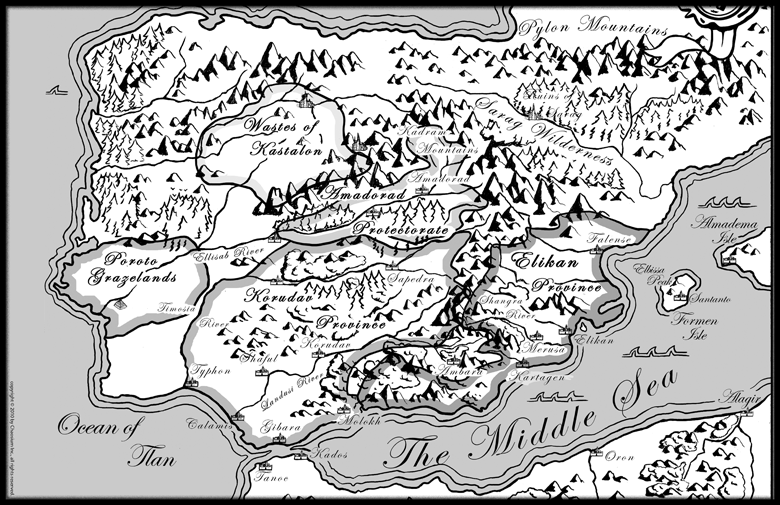


Now this is interesting: Chaosium, Inc. has released an rpg called The Chronicles of Future Earth, written by Sarah Newton and based largely on Wolfe's Urth. I have no idea what to say about the rpg itself-- I've never played it-- but it has some interesting maps. Here's another article at Akratic Wizardry and a review. 


This is my favorite cover image for Shadow of the Torturer. It was done by Don Maitz for the original Simon & Schuster edition of 1980. 

Wiki gods say, "...The Shadow of the Torturer won the annual World Fantasy Award and British Science Fiction Association Award as the year's best novel. Among other annual awards for fantasy or science fiction novels, it placed second for the Locus (fantasy), third for the Campbell Memorial (SF), and was a finalist for the Nebula...."

Wolfe's fiction has received quite a lot of critical attention, from within the genre world and from the literary world at large. In one particularly good review, "Mapping a Masterwork" by Peter Wright at Ultan's Library, The Book of the New Sun is compared to James Joyce's Ulysses:

It could be argued that The Book of the New Sun is science fiction’s Ulysses. Like James Joyce, Wolfe has ‘put in so many enigmas and puzzles that it will keep professors busy for centuries over what I meant, and that’s the only way of ensuring one’s immortality.’ 13 However, to do so would be to deny Wolfe’s determination to wed the reading process with his particular conception of existence through his games playing. From his other fiction, it apparent that Wolfe perceives the world as an ambiguous round of perceptions and misperceptions in which the individual struggles, and ultimately fails, to apprehend the precise nature of existence.


 The three images above of from Japanese editions; artwork is by Takeshi Obata.


Artist Richard Vass did this cover for the Hungarian Delta Vision edition.


Tuesday, January 21, 2014

The Eschaton Is Nigh

There's an upside to ditching 90% of your paperback collection and going all digital without really cataloging anything: in the past few years, I've been inadvertently afforded the pleasure of rereading some pretty great stuff. 

I forget; I download again; I find out three pages in. This time it was Frederik Pohl's Eschaton series: The Other End of Time, The Siege of Eternity, and The Far Shore of Time.

The Eschaton books are eminently readable but treat on some fairly hard scifi tropes: the politics of first contact, human rights issues, and of course theoretical and speculative physics (matter/antimatter transfer, cosmological theories, and more.) It's thoroughly engaging, even on the second pass.

Frederik Pohl wrote for many, many years and won pretty much every science fiction award there is. His work spanned the decades between the 1950's and his death last year in 2013 and garnered him Hugos, Nebulas, National Book Awards, Loci, and many others. 
(For those hands-busy days, Sci-Fi-London offers this great collection of radio dramas based on classic stories by Frederik Pohl and Isaac Asimov. )


Back to the Eschaton books, though. This trilogy is a later work; I was able to find full, uncropped, untreated digital versions of John Harris' cover paintings. This is a great thing, since Tor's crop job on the second of these was pretty brutal.


John Harris' original cover painting for The Other End of Time, published by Tor in 1996.


Harris' painting for the second of the trilogy, The Siege of Eternity, published in 1997.


And the third, The Far Shore of Time, released in 1999.


Tuesday, January 14, 2014

Games with Lovecraft


The hubby and I will soon be playing a round of Mansions of Madness with some of our board game group friends. We're also fans of other Lovecraft cardboard such as Arkham Horror and The Stars are Right. 


Mansions of Madness is an Ameritrash classic, with minis and murder and monsters and mayhem. Lovecraft's writing has inspired countless artists and designers of all stripes.

Seems like everyone wants to visit Lovecraft's world, if only for a few hours.


Above, illustrator Matt Buck depicts H. P. Lovecraft himself. The tentacle is everything. (I originally found this image on the Tor website, which has an entire page of Lovecraft artwork by contemporary fantasy artists.)
_


Above is a depiction of the finale of The Dunwich Horror by Alberto Breccia. You can find the entire graphic adaptation in English translation on the Ragged Claws blog.

If you find yourself interested in Breccia's work, this link will take you to a downloadable version of the entire Los Mitos de Cthulhu. These are nine stories that Breccia and collaborator Norberto Buscaglia adapted in the 70's. The text is in Spanish, of course, but art is art.


Above is a gorgeous map of one of Lovecraft's other dimensions, The Dreamlands, created by Seattle-based artist Jason Thompson. 


And here we have a 1976 cover by illustrator Murray Tinkelman, found on the blog Too Much Horror Fiction, which has a nice collection of cover art. 


This is an illustration for Lovecraft's "The Temple" done by Stephen Hickman for Science Fiction Age magazine, which went sadly out of business in 2000.


But now, back to games....


The Stars Are Right is a Steve Jackson game in which you, for some reason, are attempting to summon various Old Ones. To do so, you have to make sure that certain constellations appear in the sky by collecting cards and making patterns of them.

The artwork is fun and the game is reasonably quick. It's only ranked at 1513 on Board Game Geek, but I like it, especially on a cold foggy night.


Fantasy Flight's Arkham Horror is probably my favorite of them all. It's a long, long game with tons of fiddly bits and Byzantine rules. It's cooperative, and it's hard to win.


There are also countless role playing games based on the Lovecraft stories; Call of Cthulhu first appeared in the early 80's, and may be the original.

Yog-Sothoth is a website dedicated to the Call of Cthulhu rpgs and all their spinoffs.

Wednesday, January 8, 2014

Meeting Jack Vance

For some reason, just before grudgingly entering a week of reading deprivation imposed upon me by a program I've undertake with my husband, I started reading Jack Vance's Cadwel chronicles. Araminta Station is proving to be more of a thriller than a speculative novel, in many ways, but it's also a bot of a political exploration and a social novel. It's okay. Not great, but okay.

For some reason I was expecting space opera; maybe it was the cover art.


Above is the original Tor 1988 hardback cover by Boris Vallejo.


And above, here's a 1989 paperback cover by Bob Eggleton-- well, the upper center strip of artwork is by Bob Eggleton, and what a shame that's all we have, too.


This is the original original, published by Underwood/Miller in 1987 six months before the Tor/Vallejo edition. The cover art is by Tim White.


And above is a 1991 Tor reprint with somewhat more titillating art by Doug Beekman.


This one may be my favorite. It's a 1995 Geman Heyne edition with cover art by Dieter Rottermund. Mad Mountain indeed.